
The History of Stoner.com
From Pipeline Simulators to Self-Sovereignty
Every domain name has a story and most of those stories have been lost. Domains from the past that were registered, parked, and since forgotten. An entire generation of internet history lost to the perils of time and corrupted server backups.
Some domains though have lived full lives, passing through the hands of engineers, corporations, mergers, and acquisitions before ending up somewhere no one could have predicted.
This is the history of stoner.com. A domain that has been alive since the earliest days of the commercial internet, and one that I call home.
1993–1997: The Pipeline Era
The domain stoner.com first appeared in internet registry records in 1993, making it older than most of the world wide web as we know it.
- Google wouldn’t exist for another five years
- Altavista was the search engine that actually gave decent results
- Amazon wouldn’t start selling books for another year
- Mosaic and Netscape Navigator were the browsers of the future
This was the internet I cut my teeth on and remember fondly. Plaintext webpages, web rings, animated GIFs, guestbooks, and so many sites “under construction”. Hours lost browsing “random sites” to see what one could find, learn, and participate in.
The domain in those early days belonged to Stoner Associates, Inc. (SAI), a software company based in Carlisle, Pennsylvania. Stoner Associates had nothing to do with cannabis culture or firearms to the surprise of many. They built pipeline simulation and network modeling software for the natural gas, water, electric, and petroleum industries. The company had been around since at least the mid 1980s, steadily acquiring smaller firms and building out an enterprise software suite used by utilities around the world.

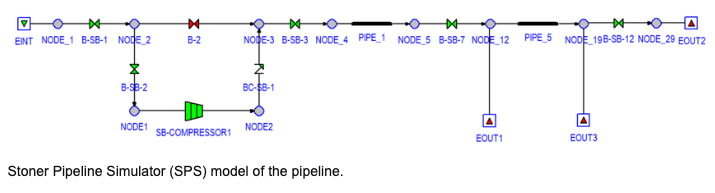 Stoner Pipeline Simulator
The first Wayback Machine snapshot of the site dates to July 22, 1997. At the time, Stoner Associates was hosting the Pipeline Simulation Interest Group (PSIG) homepage on the domain. PSIG was a niche professional organization founded in 1969, dedicated to exciting things like advancing pipeline modeling and simulation. Their annual meetings drew about 130 attendees comprised of gas company engineers, oil industry consultants, and academics from around the globe. Their agenda was to discuss transient flow dynamics, two-phase flow, optimization techniques in a characteristically “unstructured, informal manner”, and all things gas and pipelines.
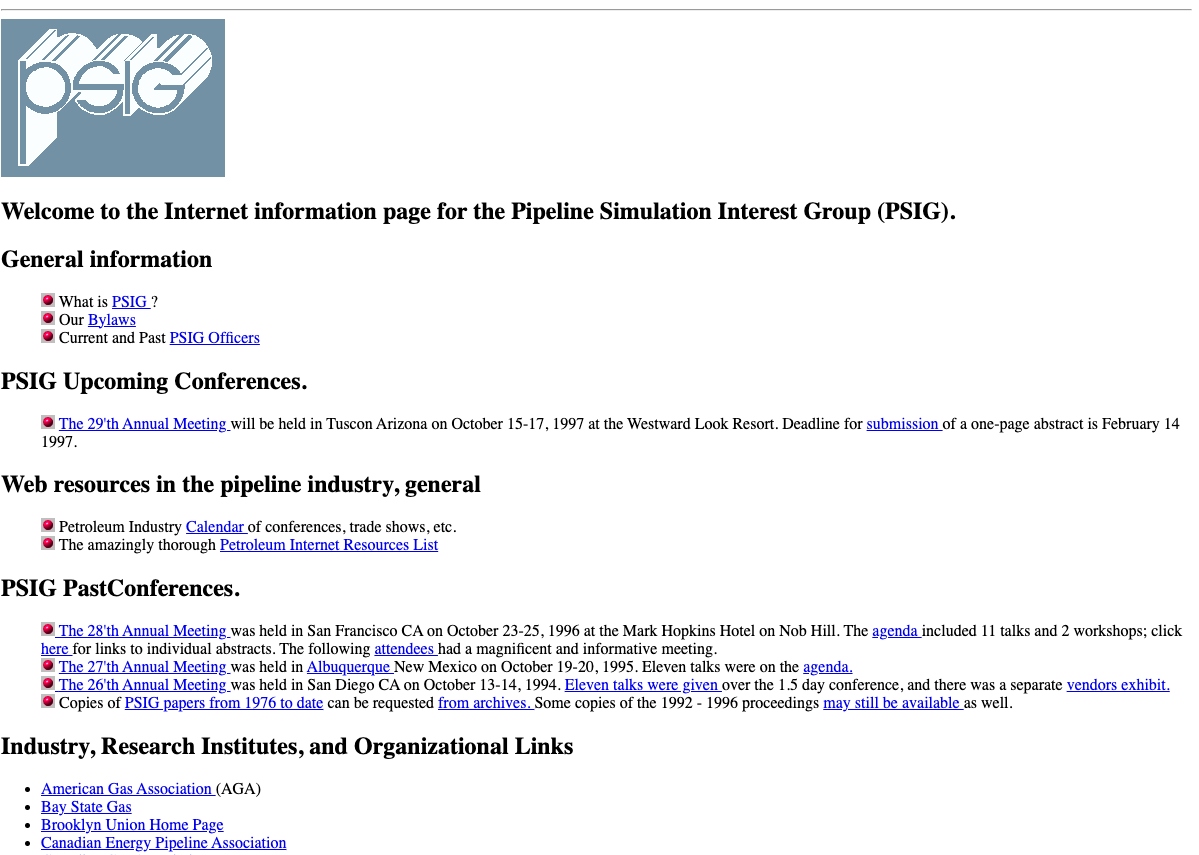 stoner.com circa 1997
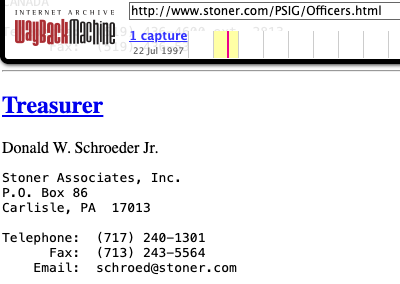
The page was pure early 1990s web with plain HTML, no CSS to speak of, a long list of hyperlinks to organizations like the American Gas Association, Chevron Pipeline Company, the Office of Pipeline Safety, and a contact directory. The treasurer’s contact was listed at the bottom — Donald W. Schroeder Jr., Stoner Associates, Inc., P.O. Box 86, Carlisle, PA 17013 with his email at schroed@stoner.com.
It was a simpler time and a simpler internet. Some would say, a better and more free internet.
Late 1997–1999: Severn Trent Takes Over
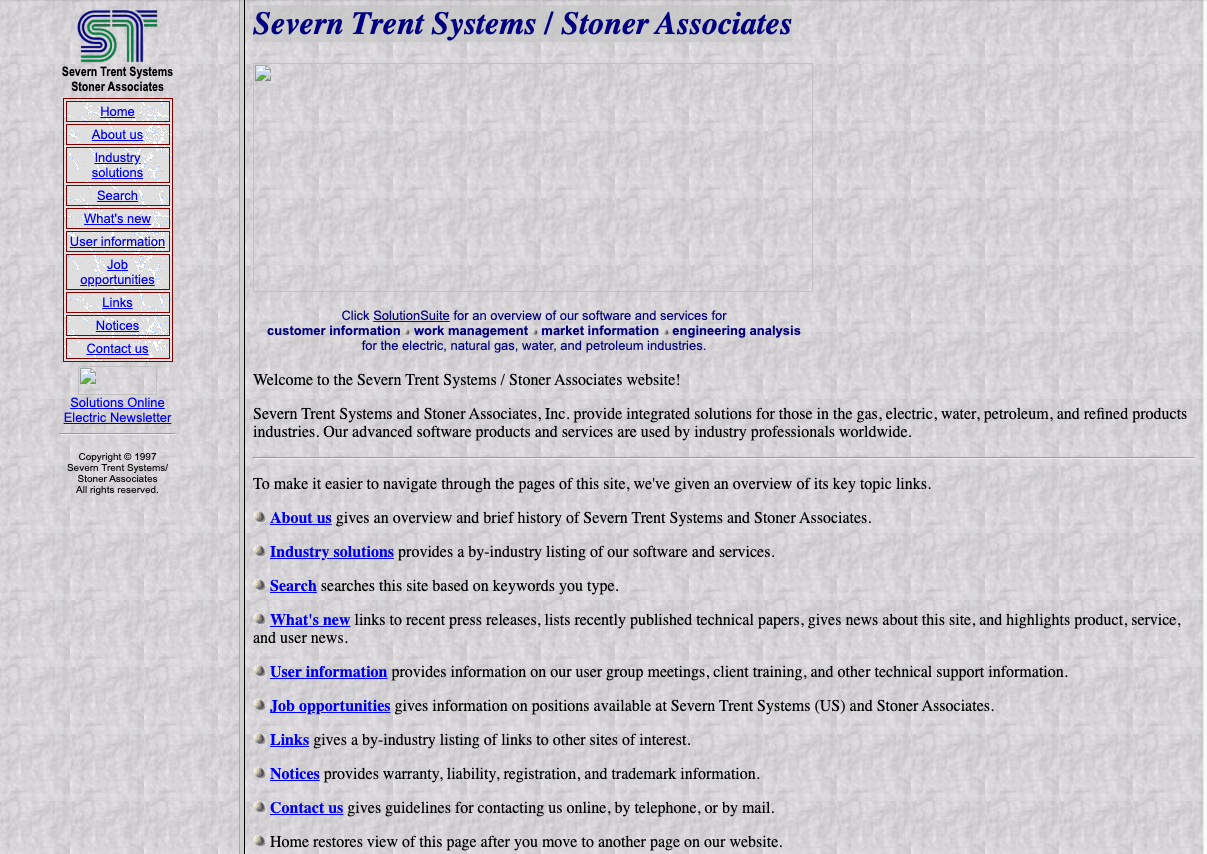 Severn Trent - 1997
By the end of 1997, the site transitioned to showcase the Severn Trent Systems group of companies. Severn Trent, a UK-based utility conglomerate, had absorbed Stoner Associates as one of three business units alongside Severn Trent Systems (US) and STS (UK).
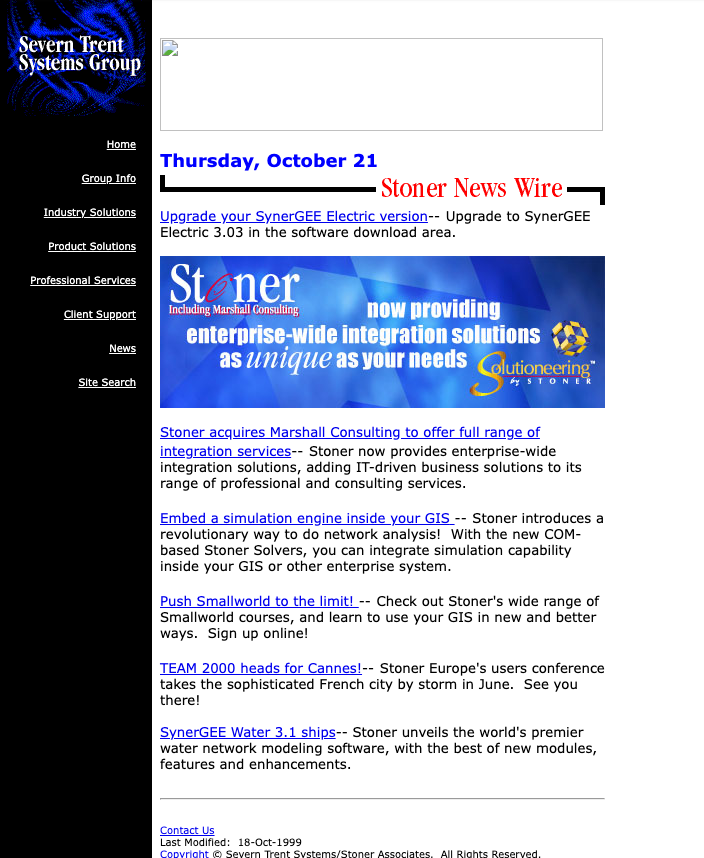 Severn Trent - 1999
The site described over 500 employees across offices in Houston, Carlisle, Phoenix, and Birmingham, England. The messaging was enterprise software through and through with taglines such as “SolutionSuite,” “world-class customer information systems,” and “network modeling products.” A timeline of acquisitions painted the picture of a company growing through consolidation.
By 1999 the site had received fresh branding and added a fifth office in Swindon, England. Stoner Associates acquired Marshall Consulting Inc. for GIS integration services and entered into official business partnerships with seven GIS vendors. The company boasted that 90 percent of the US gas distribution market was served by utilities running Stoner Associates software products.
2000–2003: Rebrands on Rebrands
The early 2000s brought the kind of corporate identity churn that defined the era. The site went through multiple rebrands while still under the Severn Trent umbrella. It had a refreshed look in 2000 and another in 2001.
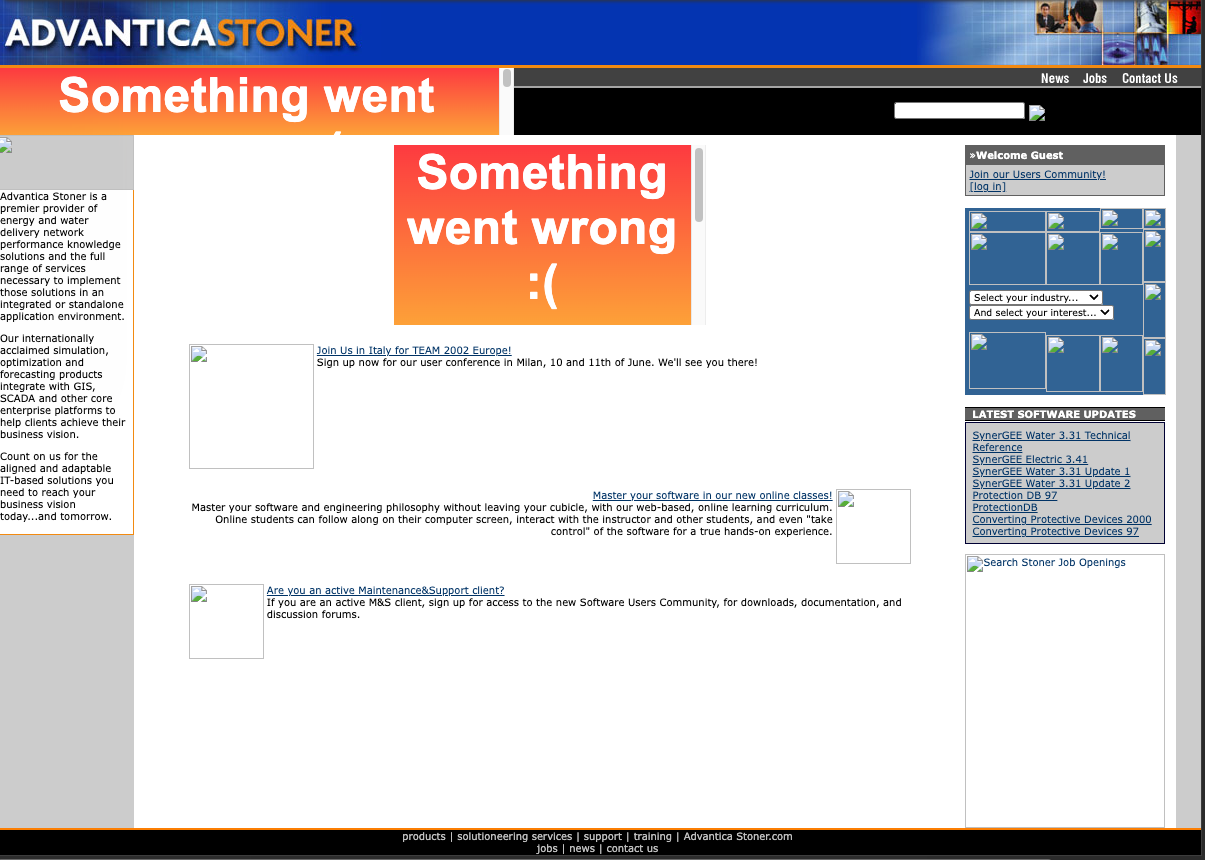 Advantica Stoner - circa Late 2001/2002
In 2001 Stoner Associates was acquired by Advantica, creating Advantica Stoner. The company moved its Pennsylvania office to Mechanicsburg later on in 2006. This will be important later in my story.


By April 2002, the domain had fully transitioned to the Advantica Stoner branding while still promoting products like SynerGEE Gas, SynerGEE Water, SynerGEE Electric, and the ProtectionDB system.
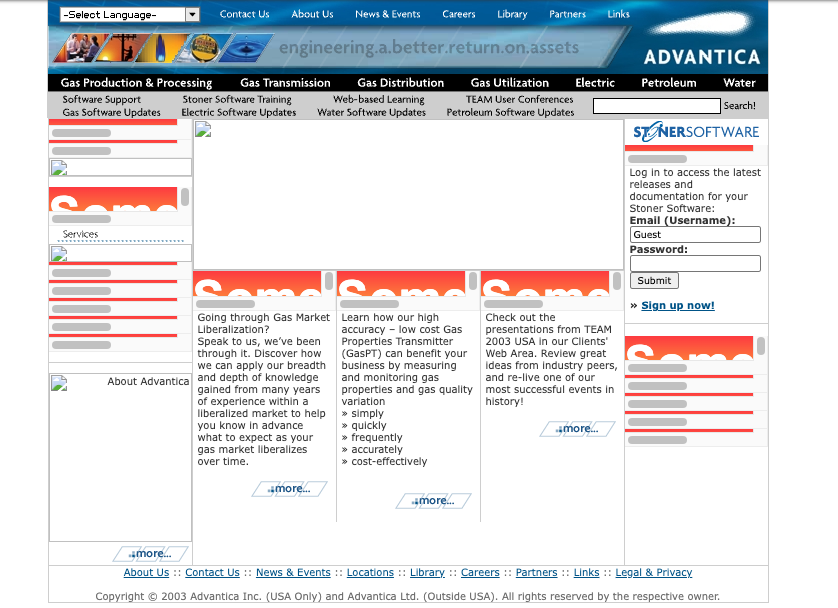 Advantica - circa 2003
By August 2003, “Advantica Stoner” was trimmed down to just Advantica, and the company pushed visitors toward advantica.biz. Another redesign followed in October under the Advantica brand.
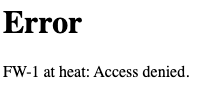 Firewall Errors - circa 2004
Then came the firewall errors. In March 2004, the site went down with a “FW-1 at heat” error indicating a Check Point firewall was overloaded or misconfigured. The site stayed broken for roughly around one to two months before coming back online in May, only to hit another denial error in June. Enterprise IT was an evolving industry at the time and monitoring, response, and remediation were not as robust as they are today. A lot of times one would only know something was down or there was an outage due to a friend telling them “Hey, I tried to get to your website yesterday and couldn’t.”
2005–2010: The Quiet Years
December 2005 brought a cleaner redesign. Less Flash, more substance. For those who weren’t there, Adobe Flash was everywhere in the early to mid 2000s. It was how you got animations, interactive menus, video players, and anything that looked cooler than plain HTML onto a webpage. Entire sites were built in Flash. It was the standard for anything that needed to move or look polished.
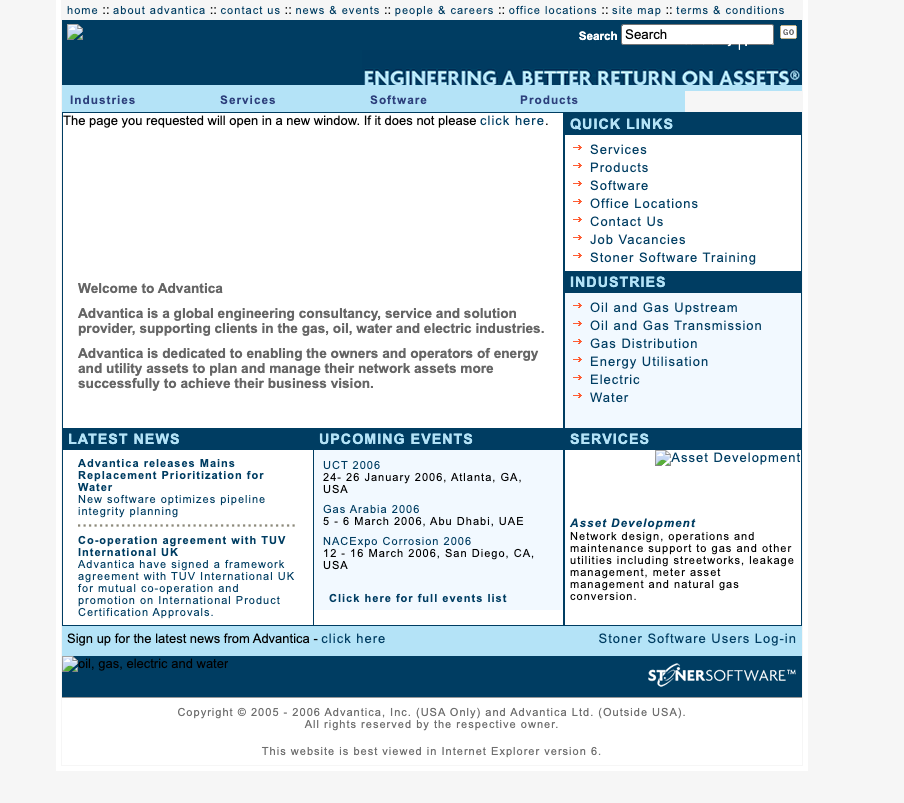 stoner.com - circa 2005/2006
The problem was Flash was a resource hog, a security nightmare, and completely invisible to search engines. It didn’t work on mobile when smartphones started taking off, and Apple’s decision to block Flash on the iPhone in 2010 was the beginning of the end. Steve Jobs publicly called it out for its poor performance and security vulnerabilities, which was the opposite take of most at the time. HTML5 and other technologies eventually replaced everything Flash could do natively in the browser with no plugins required. Adobe officially killed Flash somewhere around 2020. So stoner.com was moving in the right direction by stripping Flash out.
The site’s footer proudly declared: “This website is best viewed in Internet Explorer version 6.”
This was a timestamp of a different era entirely. Microsoft Internet Explorer dominated the web browser market for years. At its peak in the early 2000s it held over 90% of the market share. It came bundled with the Windows operating system and for most people this was the internet. That started changing when Mozilla Firefox showed up and gave people a real alternative with features like tabbed browsing, better standards, and extensions. By the time Microsoft finally put IE out of its misery in 2022, it was a joke (and had been for some time). But back then in 2005, optimizing your site for IE6 was how it was done.
From 2007 through 2010, the site was essentially dormant. Two minor content updates in 2007, two in 2008, and then nothing at all in 2009 and 2010. The domain was alive, but just barely. It is unknown if the domain was owned by Advantica at this time, or if a new owner had taken over (it looks like an acquisition happened sometime in 2007).
2011–2013: GL Noble Denton
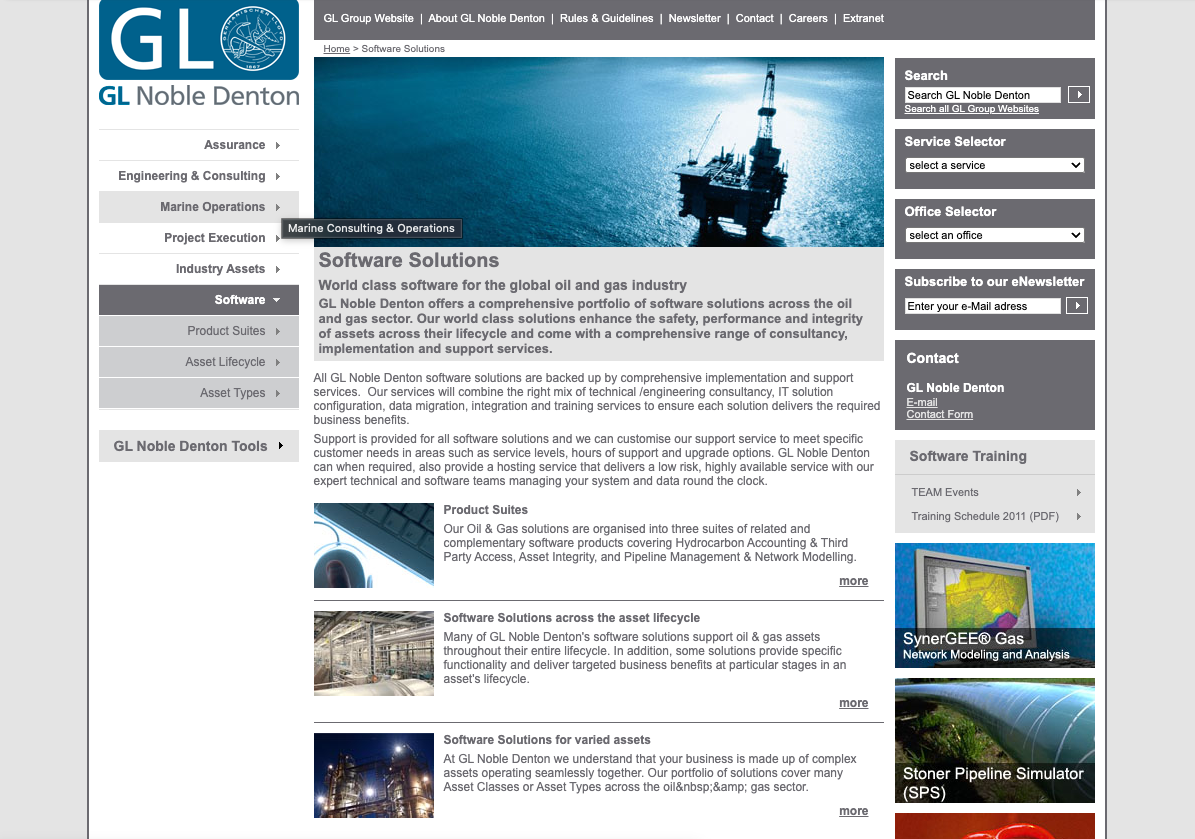 GL Noble Denton- circa 2011
In February 2011, new ownership had announced itself and the site was to follow. GL Noble Denton acquired the software business and rebranded the site entirely. Social sharing icons appeared such as Twitter, Facebook, Digg, Google, Yahoo, and Live which was indicative of the exploding social web circa 2011.
 The start of social sharing
GL Noble Denton positioned themselves as offering “a comprehensive portfolio of software solutions across the oil and gas sector,” covering safety, performance, and asset integrity. The site served this corporate purpose through 2012 providing content and redirects to their main domain.
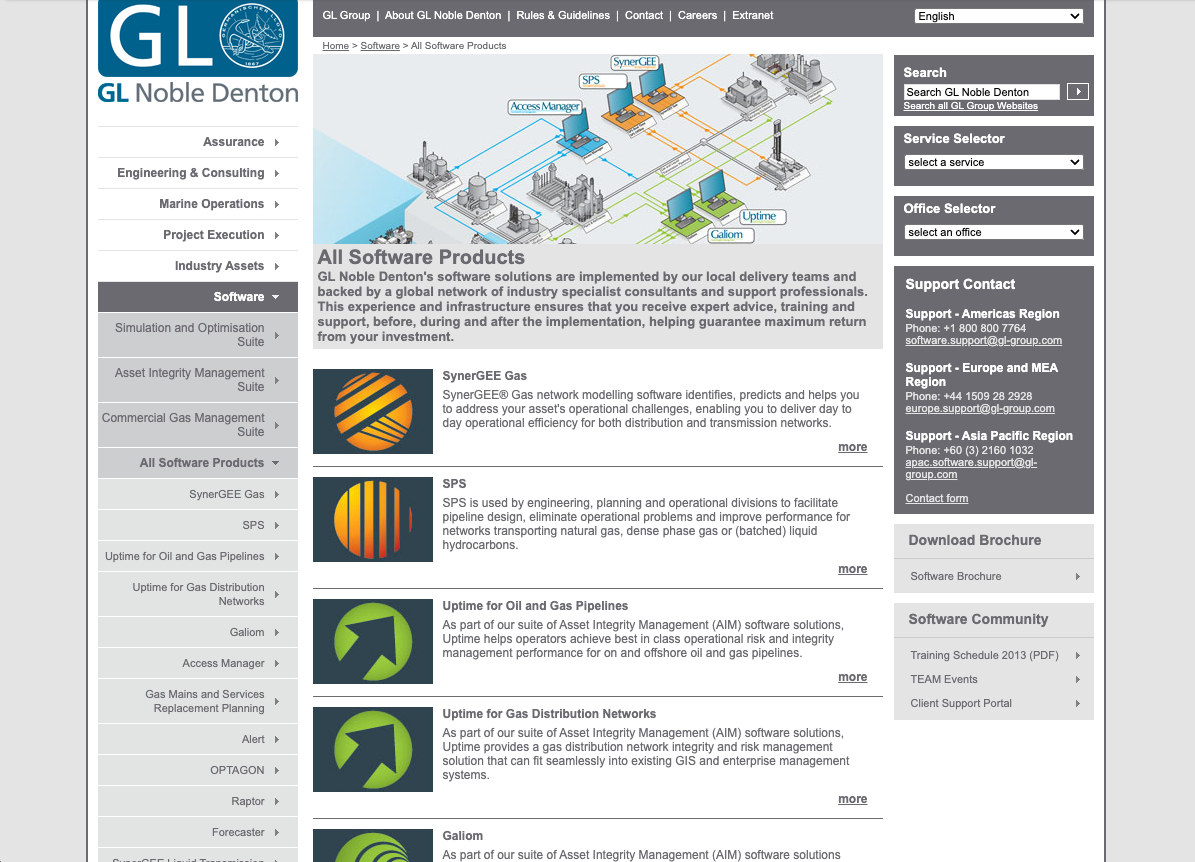
By 2013, any mention of “Stoner” had been scrubbed from the site entirely. The pipeline simulation legacy of Stoner Associates was fading into corporate archaeology. This is also around the time I started monitoring the site and checking in regularly with the owners to see if they would be interested in a potential sale. No luck on that front in 2013.
2014–2017: DNV GL and the Merger Void
In 2014, the domain changed hands again to DNV GL, a global technical advisor to the oil and gas industry, formed through the merger of Det Norske Veritas (DNV) and Germanischer Lloyd (GL). The site got a modern responsive redesign with a bootstrap style “single page” style layout, clean typography, and professional stock photography.
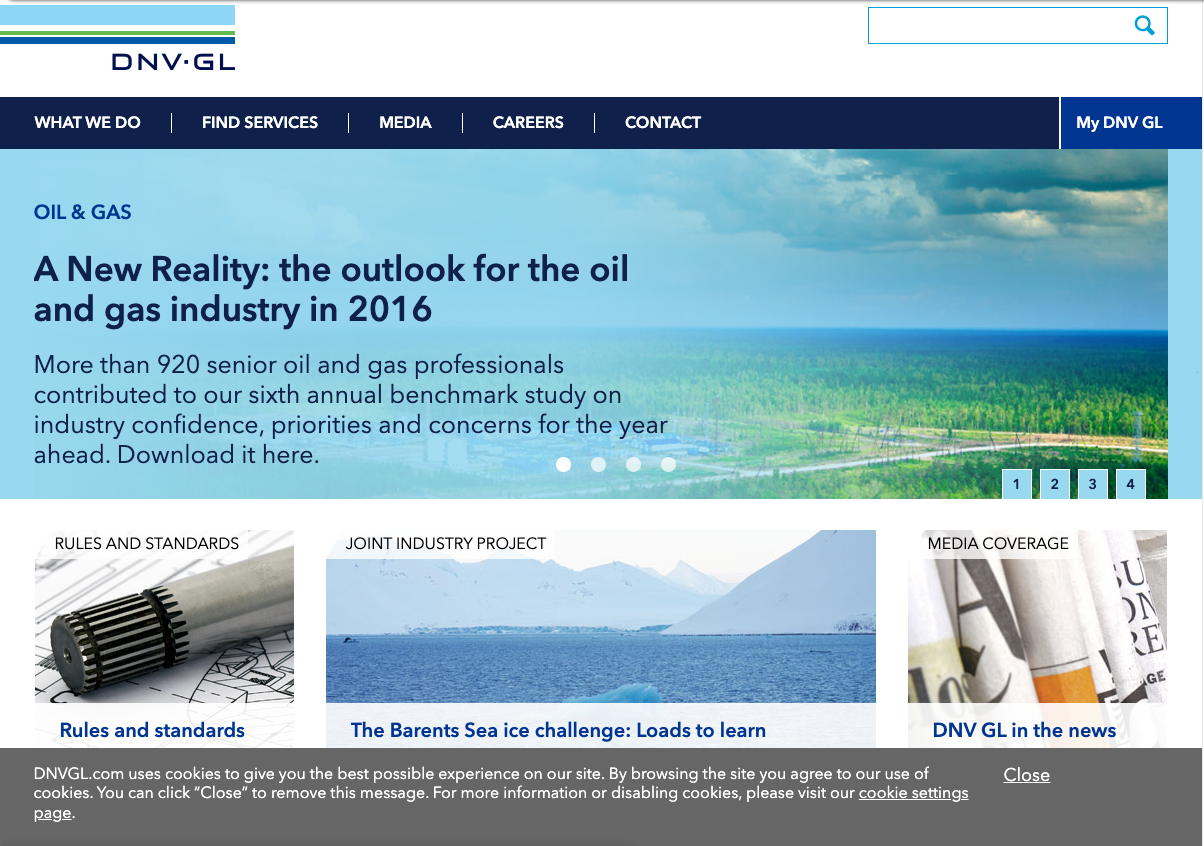 The start of cookie banners
A cookies consent banner appeared in 2015, moved from top to bottom in 2016, and various content updates trickled through. The concept of cookies had existed since the mid-90s and were small text files that websites stored on your browser to remember who you were, what was in your shopping cart, or that you were logged in. For years nobody thought twice about them. Sites just dropped cookies on your machine and that was that. No notification, no consent, no opt out, and the advertising industry loved this. Third party cookies let ad networks track you across the entire web, building profiles on your browsing habits without you ever knowing or agreeing to it. This was the data that spawned the entire internet ad, pop-ups, and advertising ecosystem.
Then the EU started pushing back. The ePrivacy Directive in 2002 laid the groundwork, but it was the 2011 update that forced websites to actually inform users about cookies and get consent. That’s when those cookie banners started slowly showing up everywhere. The real hammer dropped with GDPR in 2018, which made consent requirements even stricter and came with actual teeth. Fines that could hit 4% of a company’s global revenue.
The internet before cookie banners was cleaner to look at but far worse for privacy. You were being tracked everywhere with zero transparency. Now we have the opposite problem. Every site hits you with a popup before you can read a single word and most people just click “accept all” without reading anything. The tracking largely continues on fueling the ad and data machines.
Then in 2017, the site went to its most minimal state yet with only a scary single line of plaintext: “Following a merger, the information you are looking for is now to be found on https://www.dnvgl.com”
That was it. The 24-year history of stoner.com as a utility software domain was over, and the domain SEO (search engine optimization for page listing and ranking) would tank. The site was now a redirect notice for a Norwegian-German maritime and energy conglomerate, much like other dead and forwarded domains on the internet.
2018–2022: The Hunt
This is where I started to get ruthlessly aggressive.
I’d been watching stoner.com since around 2013. I tried unsuccessfully using domain backfill services, negotiation services and agents, and spoke to resellers in the space about my approach.
The DNV GL merger left the domain displaying nothing but a plaintext redirect message and I knew this was my chance. There was just one problem. How would I get a massive multinational corporation to sell me a six letter .com 1993 domain?
I looked up WHOIS records. I drove hours to physical addresses listed in registration data (including the old Carlisle and Mechanicsburg PA office locations). I sent LinkedIn messages. I stalked DNV GL executives on Twitter and blew up their emails and DMs (sorry). I did everything short of showing up at their Oslo headquarters with a suitcase full of money (though I did consider it and was pricing out plane tickets). The domain name was perfect. It was my name. And I was not going to let it rot as a dead plaintext redirect…
Through 2018 and 2019, the same merger message sat on the site. No updates. No response to my inquiries. I was slowly losing my mind and my window was closing.
The WHOIS records at this time still showed the domain registered to Advantica, Inc. (the old owner) with nameservers at Windstream Hosting and an admin email at dnsadmin@stoner.com. The domain was technically active, but completely abandoned in practice with no response from any of the contact addresses. Cobwebs were forming around its digital corpse.
By October 2021, even the merger message was gone now replaced by a generic hosting error:
 “Error. Page cannot be displayed. Please contact your service provider for more details. (17)”
This was not looking good, though I persisted. In August 2022 I still had not made any progress on aquiring the domain. While I was able to make contact and speak directly over the phone with some of the DNV GL IT Team and Executives earlier that year, no sale was offered, I was told to go away, and communication went quiet.
My search was effectively dead in the water. The owner didn’t want to make a sale and wasn’t interested in releasing control.
Then…after some time and by some stroke of luck the site had updated and a generic contact form appeared!
 A New Contact Form Appears - circa late 2022
Someone had either acquired the domain unbeknownst to me or was selling it as a third party. I filled the form immediately and eagerly awaited a response.
After a few rounds of communication and negotiation, I’m happy to say that in November 2022 the domain was finally transferred to me.
November 2022–Present: Resurrection
December 2022 — I put up a simple page as a test. The most simple page one can do in honor of the spirit of IT, programming, and a new awakening.
 hello world!
Hello world. After nearly a decade of watching and waiting stoner.com was mine and resurrected from the grave.
 A ressurection and new design
By April 2023, I had the site properly set up with Jekyll-based static templating, version control in a Git repository, and a build pipeline via CI/CD triggered and permissioned actions. The way a security researcher’s personal site should be built.
Today and Onward
Today, stoner.com is my home where I write about and host my projects related to security, privacy, and self-sovereign technology. The domain that once served pipeline simulation papers to 130 petroleum engineers now hosts blog posts about social media security, Bitcoin, and the fragility of the modern internet.
Timeline
| Year | Owner / Era | Site Content & Notes |
|---|---|---|
| 1993 | Unknown | Domain appears in internet registries |
| 1993–1997 | Stoner Associates, Inc. | PSIG pipeline simulation homepage |
| 1997–1999 | Severn Trent Systems / Stoner Associates | Enterprise utility software suite |
| 2000–2001 | Severn Trent Systems | Multiple rebrands |
| 2002–2003 | AdvanticaStoner → Advantica | SynerGEE product line |
| 2004 | Advantica | Firewall errors and downtime |
| 2005–2010 | Advantica | IE6 compatibility, slow fade into dormancy |
| 2011–2013 | GL Noble Denton | Oil & gas software, social media integration |
| 2014–2016 | DNV GL | Responsive redesign, cookies & banners |
| 2017–2021 | DNV GL (abandoned) | Plaintext merger redirect → hosting errors |
| 2022 | Unknown | Generic contact form |
| 2022 | Ron Stoner | Domain transferred November 11, 2022 |
| 2023–present | Ron Stoner | Security, privacy, and self-sovereignty personal site |
30+ Years of a Domain
A domain name is just a string of characters pointing at an IP address. But stoner.com has had a life and a story, as did many domain names.
- It’s been a resource for oil and pipeline engineers
- It’s been a corporate asset traded between companies on three continents
- It’s been abandoned behind firewall errors and merger redirects
- It’s witnessed various browser, coding, and protocol changes
- And now it’s a personal site run by a security engineer who wouldn’t stop sending LinkedIn messages until someone sold it to him
From Donald Schroeder’s PSIG treasurer listing in 1997, to my “hello world!” in December 2022 and onward.
If you own a domain or are in a similar situation, please consider doing the same style of documentation and history before it’s lost forever
-Ron