
Blockchain and Metaphysics: Building Reality One Block At A Time
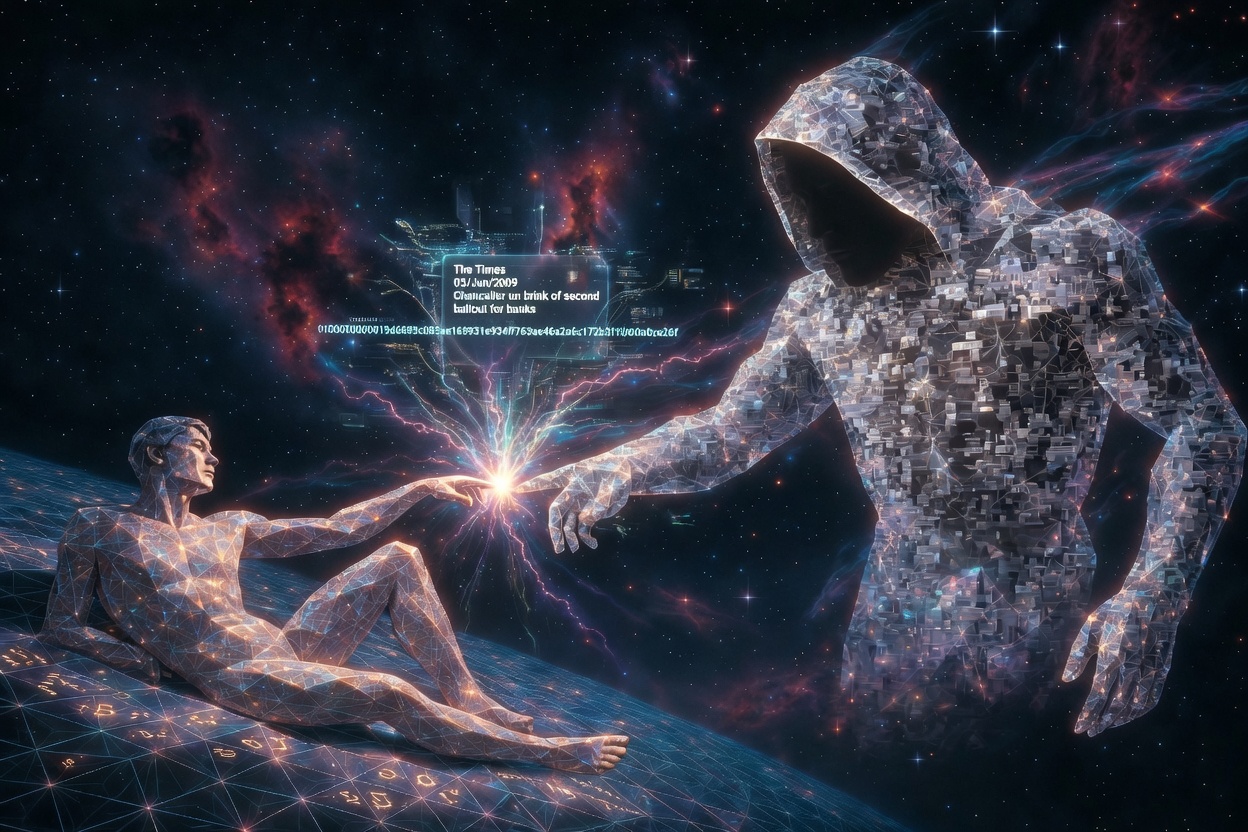
This one is going to be a little different. Strap in.
I went down a rabbit hole recently that started with the Book of Enoch (specifically the Watchers narrative in 1 Enoch), wandered through UAP material, remote viewing, near-death experiences, the holographic principle, the participatory universe, and ended up somewhere I genuinely did not expect.
The day job I spend most of my waking hours on - decentralized blockchains - turned out to be a working model of ideas that mystics and philosophers have been chewing on for thousands of years.
I am not saying the blockchain is God, though some would disagree with me.
I am not saying the validator set is a coven of angels, but Coven of Angels does sound like a cool validator company name (or motorcycle gang).
I am saying the structural problems a well designed decentralized network solves are the same structural problems contemplative traditions, cosmologists, and even some serious physicists have been debating and hypothesizing for a long time. And once you see the parallels it’s hard to unsee them.
So we’re going to have some fun with nothing too serious (as life is). Let’s map blockchain to metaphysics and see what falls out.
No Central Authority, But Coherent Global State
A well designed decentralized blockchain should not have a leader, in multiple ways. There is no king, no CEO, no central planner deciding what the next block contains. And yet every participant on the network can independently verify a single shared truth about what the state of the world is. Validators and nodes can make proposals, and the group comes to consensus. The coherence is not imposed from a center. It emerges from the protocol, which is just the rules of how nodes relate to each other.
This rhymes with a crystal (bear with me here and I’m NOT trying to sell you anything). Nobody is in charge of a crystal lattice. At a scientific level, every atom is in a specific relationship to every other atom and the pattern repeats at scale. Order without a foreman.
It is also structurally identical to what most healthy biological systems do, most healthy human communities do, and arguably what most contemplative traditions describe when they talk about how the cosmos actually runs.
- No king, no priest class, no central planner
- Just the rules of how participants relate to each other
- A coherent global truth that any participant can verify locally
- Order is an emergent property of relationships, not a top down decree
The mystics and the protocol designers ended up in the same place from completely different directions.
Trust Without Trust
The whole genius of consensus mechanisms and design is that you do not have to trust any individual node, and shouldn’t have to. You trust the structure of how nodes have to interact and have interacted. Byzantine fault tolerance (BFT) assumes some participants will be malicious, lazy, broken, or asleep at the wheel, and the system still arrives at truth.
This is a much more interesting model to me of how reality might work than either “everyone is good” or “everyone is corrupt.”
- Some nodes will lie. The system handles it.
- Some nodes will go offline. The system handles it.
- Some nodes will collude. The system has thresholds and incentives that make this hard.
- The system converges on truth, not because the participants are good but because the protocol is designed to make bad behavior expensive
Whatever the larger system we live in actually is, it seems to be somewhat Byzantine fault tolerant in the same way. Bad actors and broken people exist and always will. They have existed for as long as there have been people. Yet the patterns of meaning, justice, art, and discovery still accumulate over long timescales. That is not because humans are reliably good in my opinion. It is because the structural pattern of how attention, consequence, and memory propagate is more robust as a whole than any individual node.
Finality Is Probabilistic, Not Absolute
 Chains. In Space!
A block is “final” with increasing confidence as more blocks build on top of it. But it is never final with absolute certainty. There is always a nonzero probability of a reorganization, where the chain you thought was canonical turns out to have a longer alternate fork. This is discussed heavily in the blockchain world.
This seems to map somewhat well to how memory and history actually seem to work.
- Human memory is fallible
- Things become “what happened” through accumulated reinforcement across many witnesses (look at police investigations)
- No single authoritative declaration makes a fact final
- Occasionally the chain we thought was canonical turns out to have had a fork we missed
- Trauma victims sometimes discover their memories were corroborated decades later
- Historical events get reinterpreted as new evidence accumulates
- The Mandela Effect (yes, really) if it has any bearing, feels suspiciously like a UX bug in human memory consensus
If reality is at all collaborative, or at all responsive to attention, it may occasionally remember itself slightly differently. The strict rules version of the cosmos has no room for that kind of glitch while the probabilistic finality version expects it.
Forks As Ontology
The way blockchain forks work is honestly a more grounded model of identity and history than most philosophies offer. At a fork the chain does not “choose.” Both chains exist. The network gradually decides which one to treat as canonical. Sometimes both persist as separate networks with their own communities. Sometimes one dies off but its state is still recoverable. Sometimes dead chains can come back to life, or in a different iteration.
This gets interesting because the same style shows up in some of the most rigorous physics we have.
- The Many worlds interpretations of quantum mechanics have this structure
- Some Buddhist accounts of how karma propagates across what we naively call “lives” have this structure
- The “what if” branches we run in our own heads are forks the brain temporarily simulates in real time
- The version of you that did not move to that new city, did not take that one job, did not have that conversation at the supermarket - those branches did not vanish, the network just did not select them as canonical while they still remain in your mind
I am not making any metaphysical claims about parallel universes here, and that goes way above my pay grade and understanding. I am just pointing out that the model we use to describe forked chains is a clean way to think about contingency, which is something humans have struggled to talk about for as long as humans have been talking to each other.
Validators As Attention
In a Proof of Stake (PoS) system, validators are not passive storage. They are actively attesting, signing, attending to the state of the network. The network’s reality is constituted by their ongoing attention and participation to it and in it. If they all looked away the chain would not just be ignored. It would functionally cease to exist nor continue on.
State requires witnesses.
That is not metaphor in my profession, as it is literal protocol design. It maps onto an idea that keeps showing up in serious physics and contemplative traditions, in that reality is not just observed by consciousness, but somehow held in being by it.
- John Wheeler’s “participatory universe” is somewhat a description of how blockchains already work
- The observer problem (double slit experiment) in quantum mechanics gestures at the same thing
- Mystical traditions across cultures keep saying attention is structural
- Validators stake real value on attesting to the state of the world correctly - maybe we do too?
If reality is even a little bit participatory then what you notice, what you attend to, and what you refuse to attend to are not choices and personal preferences. They are protocol level operations. They contribute to the consensus and that changes the stakes of paying attention and participating in life. Our experiences fuel the system.
The MEV Problem As Theodicy
MEV stands for Maximal Extractable Value. It is the value that participants in privileged positions in transaction ordering can extract from the network. Block builders on some blockchains see transactions before they are confirmed. They can reorder, insert, or sandwich those transactions to capture value that a fair ordering would have left on the table.
MEV is a structural problem and a known “attack”. It is not introduced by bad people as it is a property of any system that has to sequence things.
If we take a look at the classical problem of theodicy, the question of why agents with more power, more knowledge, or more privileged positions in a system seem to extract disproportionate value from a setup that was supposed to be fair appears. The shape is exactly the same.
- MEV is not a bug introduced by a few bad actors
- It is an emergent property of systems with sequencing, asymmetric information, and/or privileged access
- Most decentralized systems have not fully solved MEV 100%, though research and work is being done
- No society has fully solved the larger problem either
- The question is not “how do we eliminate it” but “what are the mitigations, redistributions, and protocol upgrades that keep it from concentrating to a system killing degree”
Contemplative traditions call those mitigations ethics. Protocol researchers call them encrypted mempools, fair ordering, and proposer/builder separation. It’s the same problem with different vocabulary.
Resilience Through Redundancy and Diversity
Most networks tend to die when they become too homogeneous and concentrated over time. One client, one cloud provider, one jurisdiction. Networks survive when the same protocol is implemented and run by many different kinds of nodes in many different conditions.
Biology seems to have figured this out billions of years ago. Monocultures collapse and diverse ecosystems persist. Psychology figured this out too. Rigid identities crack while flexible ones bend and recover. Whatever the structure of reality is, it almost certainly has this or a similar property.
- Robust because no single failure mode can take down enough of the lattice to matter
- Diverse implementations protect the protocol from any one implementation’s bugs
- Diverse geographies protect the network from any one jurisdiction’s politics
- Diverse perspectives protect a community from any one perspective’s blind spots
- The same pattern shows up at every scale from cellular biology to civilizations
The implication is that diversity is not a moral preference. It is a structural requirement and a protocol specification of any system that wants to keep existing. Networks that forget this eventually die. Cultures that forget this calcify. People who forget this stop growing.
Turtles vs Lattices
There is an old joke about a scientist who is giving a lecture on the cosmos. An old woman in the audience tells him the world rests on the back of a giant turtle. He smiles and asks what the turtle stands on. She replies “it’s turtles all the way down.”
 Turtles all the way down
The joke is one that has stuck with me for a long time. It’s turtles all the way down. Each one a bigger version of the one above. Hierarchical, ordered, dumb. Where it stops?
No one knows.
I actually think lattices are a better model. A lattice is relational to itself and other lattices. Each node connects to other nodes. The pattern can nest such that each node is itself a lattice, where each of those nodes is itself a lattice, and the structure remains coherent because the relationships are what carry the information, not the nodes themselves.
 Or lattices all the way through?
That sounds a lot like:
- “As above, so below” (hermetic tradition)
- Indra’s Net in Mahayana Buddhism (a web of jewels where each jewel reflects every other jewel infinitely)
- The Kabbalistic sefirot (the same structural pattern repeating at every level of emanation)
- The holographic principle in physics (the information in a volume of space encoded on its 2D boundary)
- A peer to peer mesh network (every node reflecting the state of every other node, no center)
Again, different vocabularies but the same intuition.
Maybe it is not turtles all the way down, and rather it is lattices all the way through - and the participants in those lattices are not interchangeable. What each node attends to, how each node relates to other nodes, what each node signs and what it refuses to sign, all of that propagates through the structure.
Where This Ultimately Lands
Time to be real.
- Blockchain is not a religion. I am not asking you to believe anything or buy anything. Nor do I want you to.
- This is not a takedown of religion either. The traditions noticed real things and built useful vocabularies for them (even if the institutional layers got real weird about it later on).
- This is not a claim that physics has been solved by blockchain engineers, though that would be extremely funny if true. We are still very much in the dark on the big questions and it’s not our time to understand fully yet.
- This is an observation that the same structural problems keep showing up at every scale of life, and the people working on those problems in code, in protocols, in economics, in game theory, in physics, in contemplation, are all rhyming somewhat with each other whether they know it or not.
I keep coming back to a thought: is decentralized network design a kind of applied cosmology and world building, even when nobody calls it that?
- How does coherent order emerge without a tyrant?
- How do you build trust where trust cannot be assumed?
- What is the right relationship between individual autonomy and collective state?
- How do you handle bad actors without becoming authoritarian?
- How do you make a system resilient to failure without making it brittle to change?
Those are not just engineering questions. They are life questions all the way up and all the way down. The answer space seems finite and humanity keeps stumbling into the same answers from different doors, or maybe we are the creative nerve of the universe figuring itself out one block and transaction at a time, awaiting finality. Maybe we are just monkeys with GPUs pattern matching across vocabularies.
The honest answer is that no one knows.
And I am increasingly comfortable not knowing.
What I do know is that the next time I am reviewing a consensus mechanism or execution flow, I am going to be thinking about it a little differently and more universally.
The block builders and the mystics are working on the same problem.
Its just turtles all the way down.
Or rather - lattices.